Before the Leisure Centre: The Rise of the Public Pleasure Garden
Public pleasure gardens made recreation a shared outing: learn how their walks, music and sociable rituals shaped a distinctive kind of leisure.
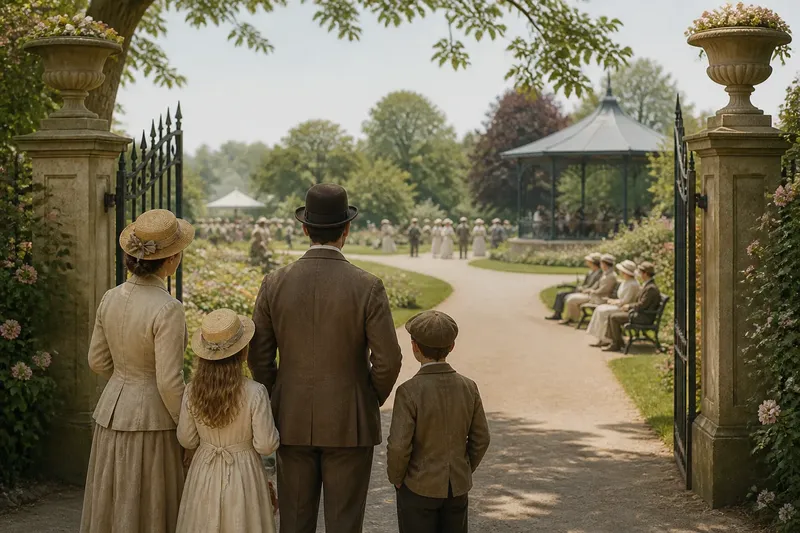
A family pauses at the gate of a pleasure garden, deciding whether to follow the path towards the music or find a quieter place to sit. Public pleasure gardens offered a setting for this kind of planned outing: a place to walk, meet others and encounter organised entertainment. Their history is best understood through particular venues and surviving descriptions, rather than broad claims about how leisure changed everywhere.
What made a pleasure garden a destination?
A pleasure garden combined landscaped grounds with activities that could give visitors a reason to stay. Depending on the venue and occasion, these might include paths for strolling, music, performances or refreshments. The attractions were not identical from garden to garden, and a visitor’s experience depended on what was offered at the time.
“Public” did not necessarily mean free or unrestricted. Some gardens charged admission, and travel to them also took time and resources. Owners and organisers set the terms of access and managed the grounds as commercial places of recreation. Visitors could make choices once inside, but those choices sat within a setting arranged by someone else.
How did visitors spend their time?
Strolling could be an activity in its own right. A path let visitors move through the grounds without aiming for a single destination, while offering chances to pause, talk or notice the landscape. Music and other entertainments supplied a shared focus; refreshments offered another reason to stop.
The mixture allowed a visit to change pace. Companions might watch a performance, resume their walk and then sit together. Other visitors might prefer one attraction or spend more time observing the crowd. The balance between quiet movement and public entertainment varied with the garden, the occasion and the people who came.
Being seen among other visitors could be part of the social experience, but it would not have meant the same thing to everyone. A lively crowd might suit one person and leave another feeling exposed. The gardens offered shared space, not a promise of privacy.
How did organisers shape the outing?
Paths and gathering places gave visitors ways to move through the grounds, while scheduled entertainment could draw them to a particular spot at a particular time. Refreshments made a pause possible; admission helped support the venue. These features shaped an outing without necessarily imposing one fixed itinerary.
Imagine a group arriving with only a meeting place agreed. They follow a path, stop when music catches their attention, then sit together before wandering on. The likely result is a visit built around a few shared moments, with room for individual preferences. The example illustrates how an organised venue could still leave some decisions to its visitors; it does not establish how every garden or group behaved.
What questions clarify the history of pleasure gardens?
Were public pleasure gardens free to enter?
Not necessarily: some operated commercially and charged admission or fees for particular attractions. “Public” can describe a venue intended for visitors without implying that entry was free to all.
Were pleasure gardens the same as public parks?
Both could offer outdoor space, but a pleasure garden might also provide organised entertainment or commercial services. The distinction depends on the particular venue; the labels should not be treated as interchangeable in every historical context.
Did every garden offer music and refreshments?
No single list describes every garden or every occasion. The available attractions could vary, so claims about a specific venue need support from information about that place and period.
Why compare pleasure gardens with leisure centres?
The comparison is useful only at a broad level: both are managed venues where people can spend leisure time. Pleasure gardens centred on outdoor grounds and sociable entertainments, while a modern leisure centre has a different purpose and setting.
What should a visitor keep in mind?
When considering a particular pleasure garden, check what evidence supports claims about its admission, attractions and visitors. A surviving advertisement may describe what organisers offered, but it does not by itself establish who attended or how they experienced the place. Accounts from different kinds of sources can help distinguish an advertised intention from a documented practice.
- Observe whether a source names a specific garden and date; if it does, tie the claim to that venue and period, but if it does not, avoid presenting it as a general fact.
- Observe whether an advertisement mentions an entrance charge; if it does, describe the stated terms for that occasion, but if it does not, do not infer that entry was free.
- Observe whether a source lists music or performances; if it does, say that the attraction was advertised or recorded, but if it does not, leave the programme unspecified.
- Observe whether refreshments are explicitly mentioned; if they are, attribute their availability to that source, but if they are not, do not assume visitors could buy them.
- Observe whether a source describes who attended; if it does, report only the group it identifies, but if it does not, avoid claims about the social reach of the garden.
- Observe whether a source records visitors’ experiences rather than an organiser’s intentions; if it does, distinguish that account from advertising, but if it does not, describe the intended offer rather than its effects.
It is not worth forcing every pleasure garden into one story of progress towards modern recreation. A more careful account asks what a named venue offered, who could reach it and what the available evidence can actually support. That approach keeps the public pleasure garden in view as a distinctive place for outdoor leisure, without claiming more than its record can tell us.